

Re-Noted: Benjamin Franklin's Productivity Notes
"...henceforth, I may live in all respects like a rational creature."

Benjamin Franklin (1706-1790) has been called the “patron saint of self-improvement guides”1 for good reason. He spent his life trying to live more perfectly. In his remarkable autobiography, Franklin recounts several ways he used his notebooks to work towards what he called “moral perfection.”
At 20 years of age, Franklin penned his first list of resolutions. He lamented that he had lived his life thus far without direction. He corrected this with a “Plan of Conduct” that included a list of “resolutions.” He declared that
henceforth, I may live in all respects like a rational creature.2
Franklin’s resolutions focus on frugality, morality, and industry—three of his lifelong obsessions. They are as follows:
1. It is necessary for me to be extremely frugal for some time, till I have paid what I owe.
2. To endeavour to speak truth in every instance; to give nobody expectations that are not likely to be answered, but aim at sincerity in every word and action—the most amiable excellence in a rational being.
3. To apply myself industriously to whatever business I take in hand, and not divert my mind from my business by any foolish project of growing suddenly rich; for industry and patience are the surest means of plenty.
4. I resolve to speak ill of no man whatever, not even in a matter of truth; but rather by some means excuse the faults I hear charged upon others, and upon proper occasions speak all the good I know of every body.3
Franklin claimed to have followed these rules throughout his life. In reality, he had only mastered Rules 1 and 3. Telling the truth wasn’t his strong suit—but that would come in handy in his diplomatic mission to convince the French to assist with America’s Revolutionary War.

Franklin was a heroically imperfect man—he wasn’t always great at the virtues he encouraged in others (fidelity and honesty are stand outs). Yet, in other respects, he could be remarkably principled. He maintained an enviable work ethic, and his accomplishments are too numerous and varied to name in full, so here’s a partial account.
He pulled himself out of poverty and started a successful printing house.
Fascinated by the natural world, he conducted experiments that moved scientific knowledge forward, innovating lightening rods and bifocals—to name two of his more successful ventures.
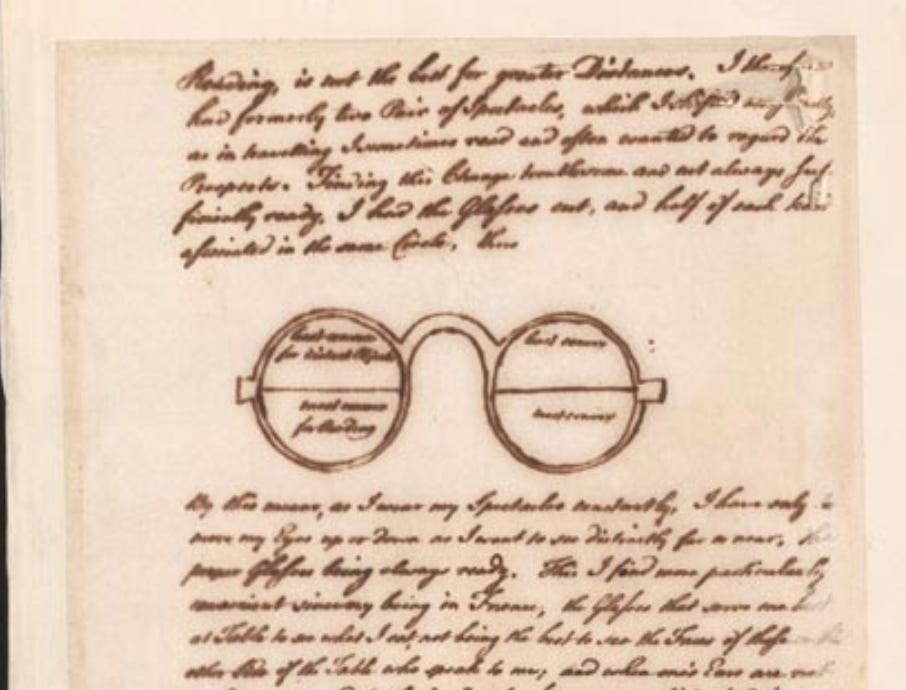
He was an important diplomat and advisor during America’s revolutionary period.
He had a hand in drafting the Declaration of Independence and the U.S. Constitution—I’ll discuss this in this week’s postscript.
Through it all, Franklin kept copious notes.
Franklin’s Private Liturgy
For Franklin, self-improvement and productivity were religious matters. Because he tired of organized religion early in his life, Franklin composed his own personal liturgy. The title page reads:
Articles of Belief
and
Acts of ReligionIn Two Parts.
Here will I hold—If there is a Pow’r above us
(And that there is, all Nature cries aloud,
Thro’ all her Works), He must delight in Virtue
And that which he delights in must be Happy. Cato.
Part I.
Philada.
Nov. 20, 1728.
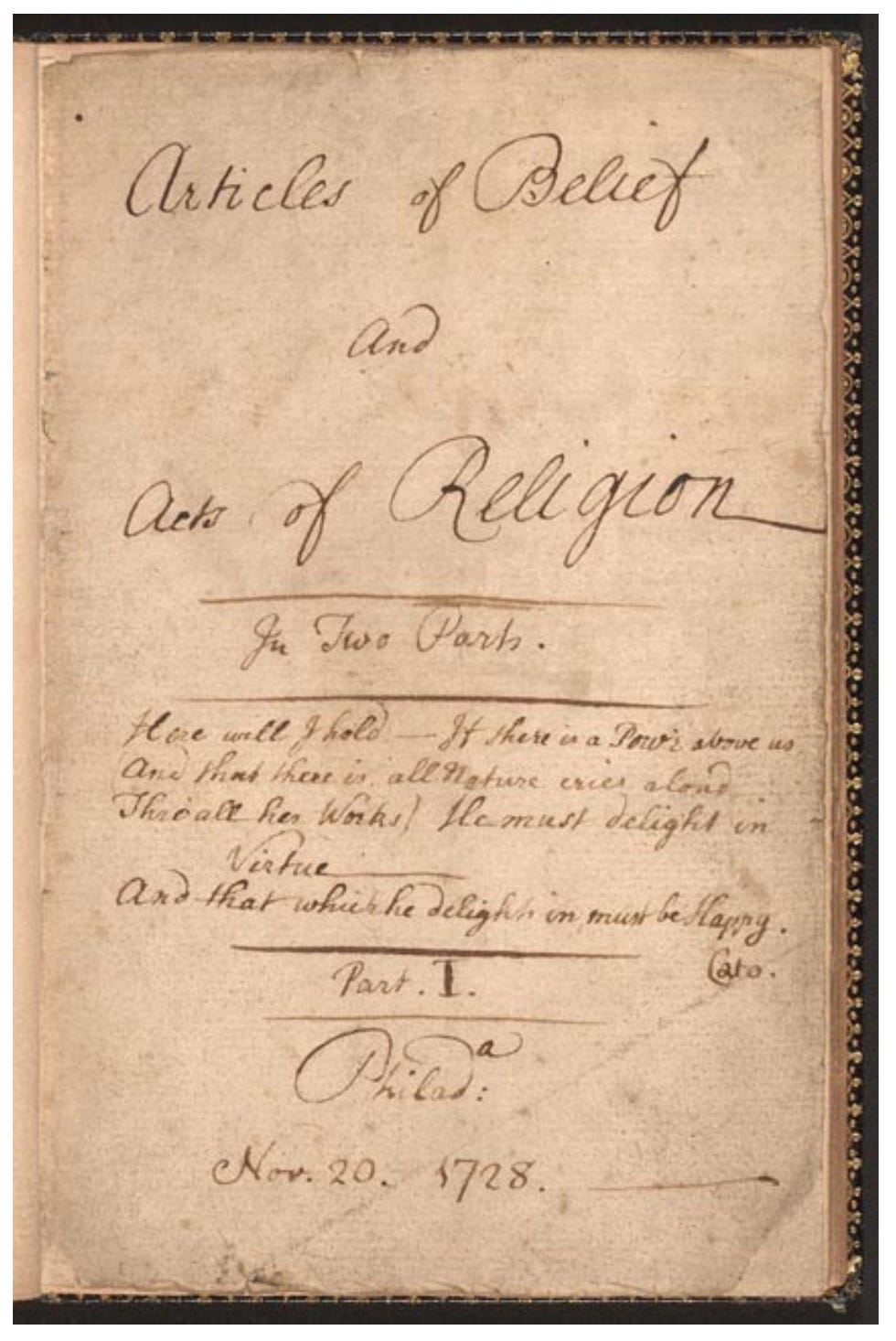
In this notebook, Franklin lays out his “duties” as a Christian. These are remarkably similar to the “code of conduct” he laid out for himself in the resolutions described above. For example, in his private liturgy he prays:
That I may be sincere in Friendship, faithful in Trust, and impartial in Judgment, watchful against Pride, and against Anger (that momentary Madness)…
That I may be just in all my Dealings and temperate in my Pleasures, full of Candour and Ingenuity, Humanity and Benevolence…4
You can read the entire transcript of Franklin’s private liturgy here.
When it came to tracking his moral virtues, Franklin made another little book for himself —perhaps his most famous attempt at self-improvement.
Franklin’s Moral Accounting
In his quest towards “moral perfection,” Franklin tracked virtues he aspired towards in another notebook—he included the same quote from Addison’s Cato, A Tragedy used in his private liturgy.
Franklin explains that he “made a little book in which I allotted a page for each of the virtues.”2 Here are Franklin’s descriptions of each of the virtues:
1. TEMPERANCE. Eat not to dullness; drink not to elevation.
2. SILENCE. Speak not but what may benefit others or yourself; avoid trifling conversation.
3. ORDER. Let all your things have their places; let each part of your business have its time.
4. RESOLUTION. Resolve to perform what you ought; perform without fail what you resolve.
5. FRUGALITY. Make no expense but to do good to others or yourself; i.e., waste nothing.
6. INDUSTRY. Lose no time; be always employ’d in something useful; cut off all unnecessary actions.
7. SINCERITY. Use no hurtful deceit; think innocently and justly, and, if you speak, speak accordingly.
8. JUSTICE. Wrong none by doing injuries, or omitting the benefits that are your duty.
9. MODERATION. Avoid extreams; forbear resenting injuries so much as you think they deserve.
10. CLEANLINESS. Tolerate no uncleanliness in body, cloaths, or habitation.
11. TRANQUILLITY. Be not disturbed at trifles, or at accidents common or unavoidable.
12. CHASTITY. Rarely use venery but for health or offspring, never to dullness, weakness, or the injury of your own or another’s peace or reputation.
13. HUMILITY. Imitate Jesus and Socrates.5
Sensibly, Franklin decided to tackle one virtue at a time. He tracked his daily progress over the course of a single week.
Here, Franklin shows us the chart for Temperance’s week. He listed the days of the week on the horizontal axis. On the vertical axis, he lists the 13 virtues. Upon examining his day, Franklin would use a black dot to signal times that he failed to practice that day’s virtue. (Silence and order seemed to be particularly difficult for him.)
This image comes from his draft for his Autobiography:
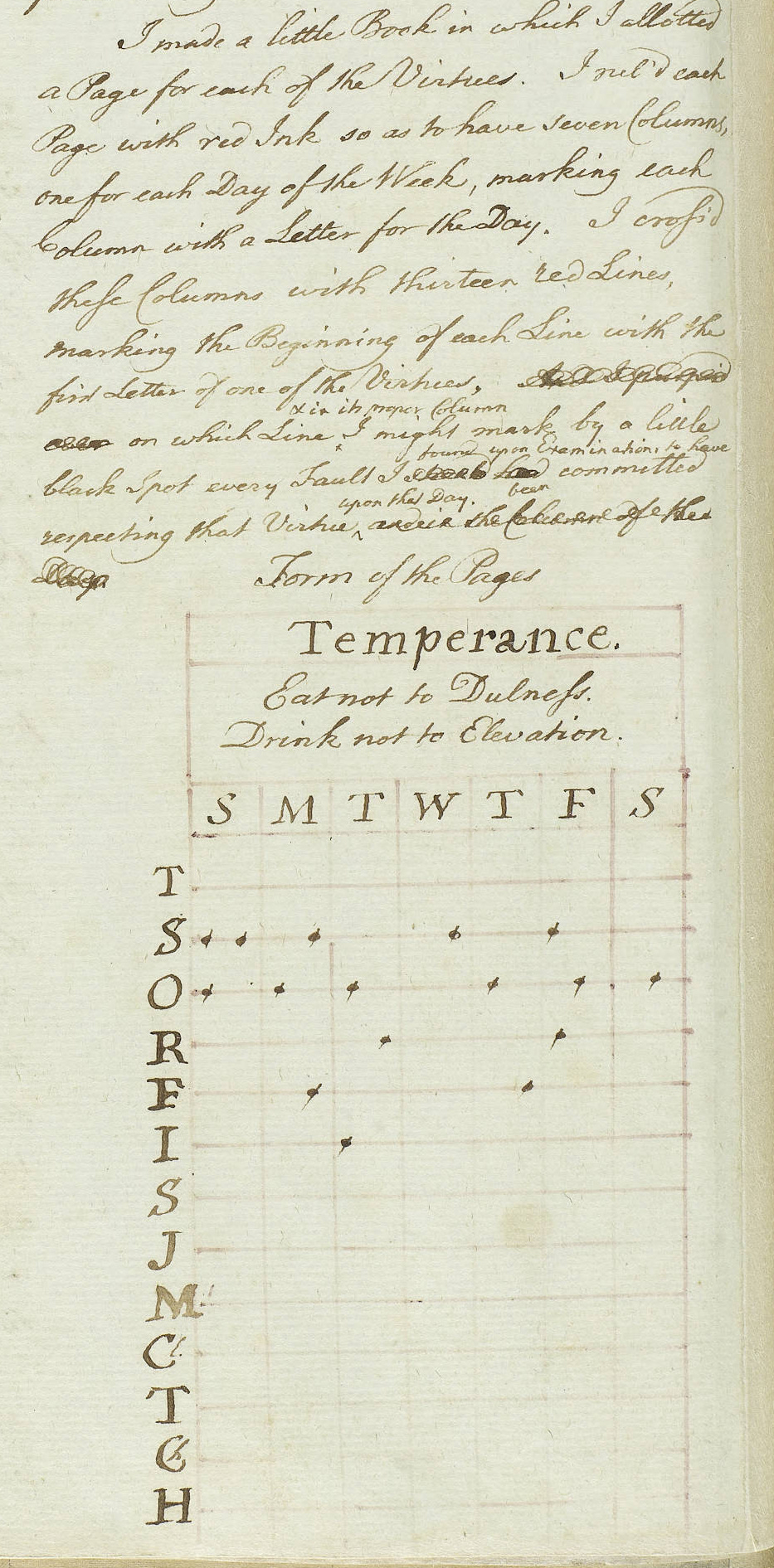
Franklin’s little book for tracking virtues does not survive because he only created a single table for tracking faults. Thus, every week, he’d have to erase his marks.
Erasure was difficult in a time before mass-produced erasers. In fact, the most common method of erasure in Franklin’s time was rubbing bread over the markings.6 This constant rubbing destroyed the paper, which Franklin admits “became full of holes…”7
His solution was to use a notebook made of ivory, rather than paper. This was easy enough, as Franklin sold such notebooks in his shop. Unfortunately, Franklin’s ivory notebook didn’t survive, but Thomas Jefferson’s did—with his writing intact!
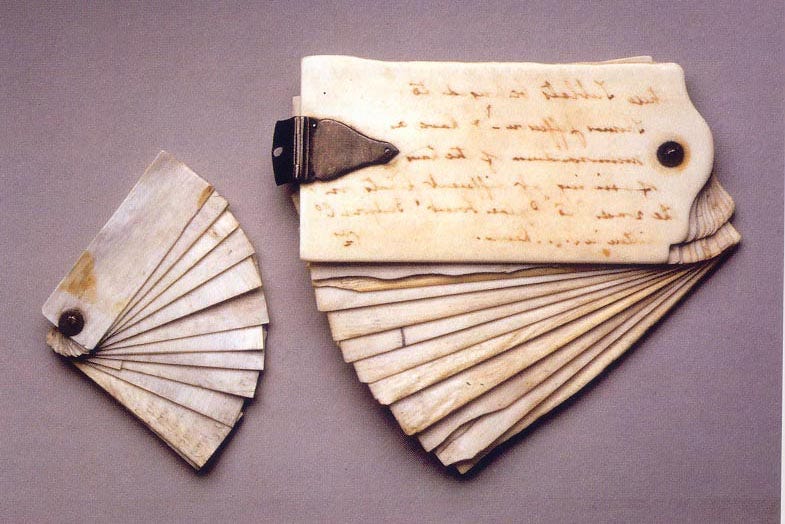
In his Autobiography, Franklin describes how he prepared his ivory notebook:
I transferred my tables and precepts to the ivory leaves of a memorandum book, on which the lines were drawn with red ink, that made a durable stain, and on those lines I marked my faults with a black-lead pencil, which marks I could easily wipe out with a wet sponge. After a while I went through one course only in a year, and afterward only one in several years, till at length I omitted them entirely, being employed in voyages and business abroad, with a multiplicity of affairs that interfered; but I always carried my little book with me.8
As we move further away from January (and the season of resolutions), it is worth noting that Franklin devoted his entire life to his resolutions, which he first described as a 20-year-old. Franklin would certainly be in favor of resolutions, but he would caution us not to put too much pressure on any single month—or year. After all, the project of “moral perfection” is a lifelong endeavor.
Notes on Benjamin Franklin’s Notes
Align your resolutions and your values: Franklin teaches us that the best resolutions are those that move us towards a greater goal—whether that be industry, honesty, or truthfulness. Franklin understood his ambitions to be one and the same with his religious values.
Write out your resolutions: You might even create a little notebook like Franklin’s to guide your own spiritual journey.
Track your progress: Franklin kept an early version of a bullet-journal. The best way to know if we are improving is to track our progress as Franklin did with his table of virtues.
Noted is fueled by you. Your ❤️’s and comments inspire me. As always, I would love to know your thoughts.
Yours in note-taking,

P.S. Paid subscribers, can read a postscript to this post: 4 Writing Tips from Benjamin Franklin.
P.P.S. I was at a conference this past week and didn’t have quite enough time to finish the postscript on Emily Brontë. Paid subscribers will find it in their inboxes next Monday.
Isaacson, Walter. Benjamin Franklin: An American Life. Simon & Schuster, 2004, p. 70.
Franklin, Benjamin. Founders Online: Plan of Conduct, 1726. University of Virginia Press. The original has been lost, but (thankfully) Franklin allowed a friend to make a copy of this document before it disappeared.
Franklin, Benjamin. Founders Online: Plan of Conduct, 1726.
Founders Online: Articles of Belief and Acts of Religion, 20 November 1728. University of Virginia Press, http://founders.archives.gov/documents/Franklin/01-01-02-0032.
Franklin, Benjamin. The Autobiography of Benjamin Franklin. H. Altemus, 1895.
Stallybrass, Peter. “Benjamin Franklin: Printed Corrections and Erasable Writing.” Proceedings of the American Philosophical Society, vol. 150, no. 4, 2006, pp. 553–67.
Franklin, Benjamin. The Autobiography of Benjamin Franklin. H. Altemus, 1895.
Franklin, Autobiography.
Your archival work keeps revealing the same pattern. The infrastructure behind creative output. Grimms cataloging 700+ books with margin notes, Brontës' scribble mania on every scrap, now Franklin tracking virtues daily for decades. The romantic myth obscures the systematic labor. Writers resist this because it feels mechanical, but Franklin carried that little book his entire life. Tracked, erased, tracked again. That's how sustained work happens. Really compelling research. 🐦⬛
I'd never heard of the bread erasure -- or why paper didn't last. Fascinating!