

Three Notebooks Behind Thomas Jefferson's Legacy
"I determined to abridge in a common place book, every thing of value which I read."

On July 4th, 1776, the Second Continental Congress formally adopted the Declaration of Independence. Exactly fifty years later, its author, Thomas Jefferson (1743-1826) died on July 4th, 1826—waiting to see one more birthday of the country he helped to found. This week—two hundred and fify years after the Declaration—we celebrate America: the improbable, still ongoing, experiment of running a country free from tyranny.
Thomas Jefferson’s theories of freedom and justice—complicated though they may be for a man who wrote about liberty while enslaving people—are deeply rooted in the very idea of America. And so much of Jefferson’s thinking about the law and human prosperity was rooted in the three commonplace books he kept during his life: collections of literary quotations and legal precedent.
So before we celebrate July 4th this week, let’s look at three of the most foundational notebooks kept by one of America’s founding fathers. The following three commonplace books show how Jefferson arrived at his legal and philosophical ideas through rigorous study.
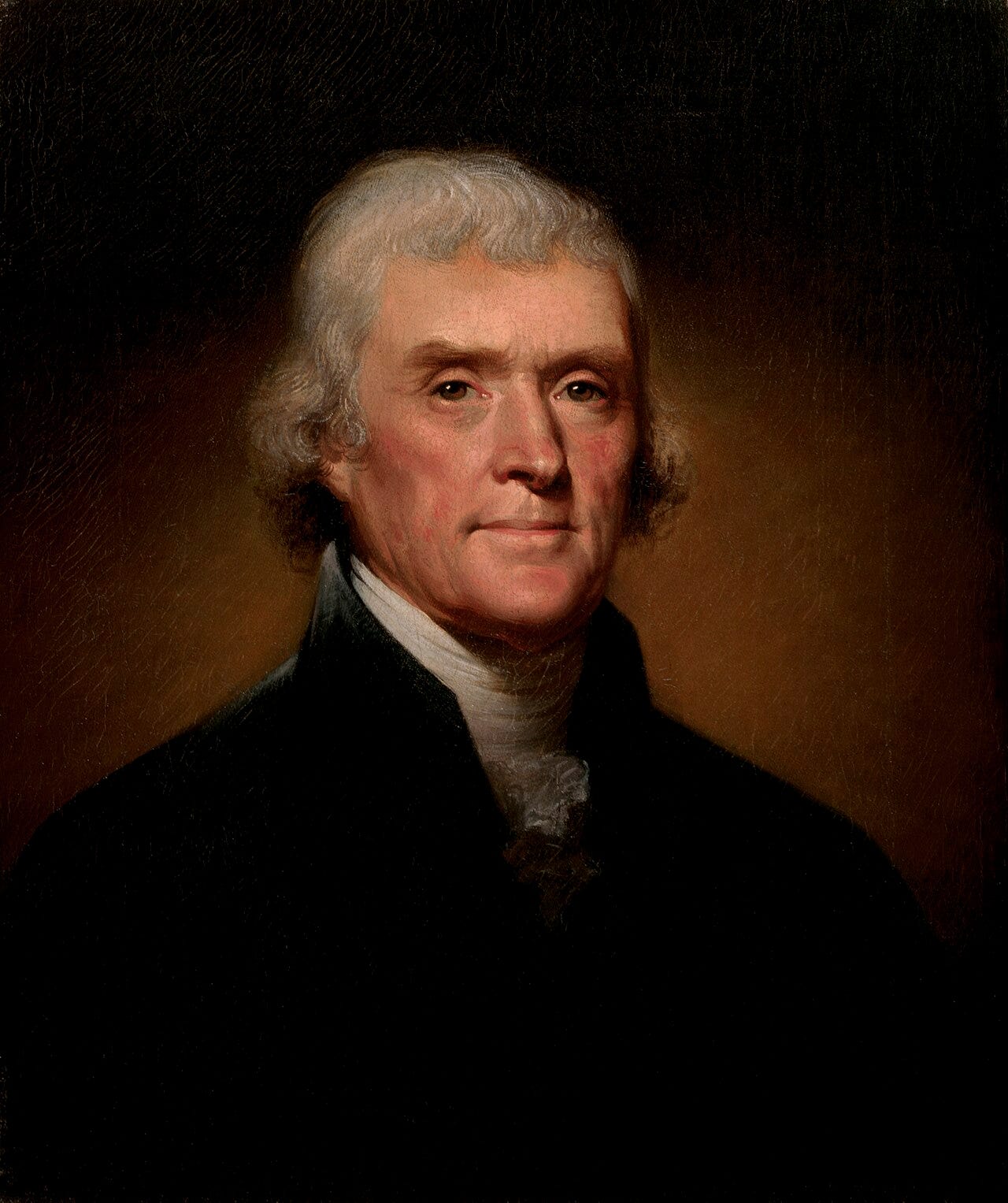
Jefferson’s Literary Commonplace Book
In 1760 (at the age of seventeen), Jefferson began his first commonplace book—filled with literary excerpts—and continued to add to it until 1772. Thus, it offers an incredible view into young Jefferson’s mind and his intellectual formation.
Jefferson began with the ancient historian, Herodotus, which is not necessarily a surprising choice. However, what I did find surprising was that these extracts are about circumcision.
the Colchians, the Egyptians, and the Ethiopians are the only nations that have from the first practised circumcision. The Phoenicians and the Syrians of Palestine acknowledge of themselves that they learnt the custom from the Egyptians.1
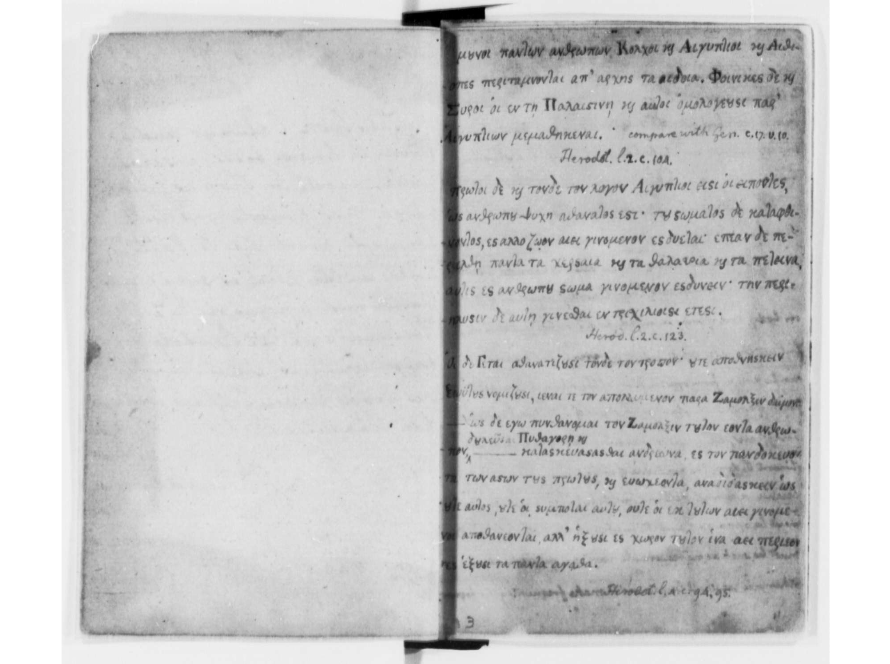
The editors of Jefferson’s papers suggest that his interest in circumcision is part of a larger interest in the Bible’s historicity. After this page, Jefferson transcribes long extracts from Bolingbroke—an 18th-century politician and philosopher—that interrogate foundational ideas, especially those found in the Bible.
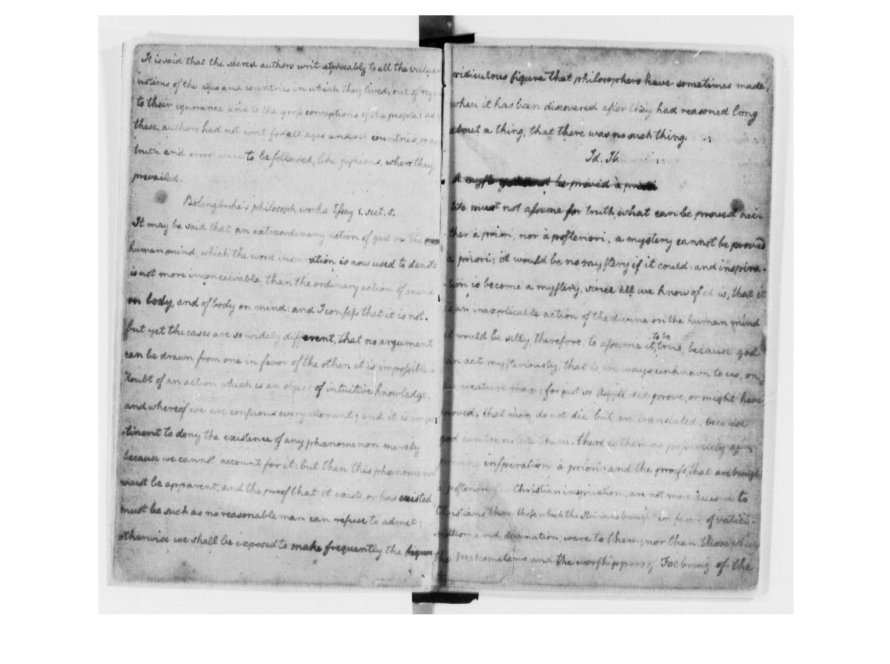
The underlying theme here is to question received wisdom and to come to one’s own conclusions. He transcribes the following from Bolingbroke:
No hypothesis ought to be maintained if a single phaenomenon stands in direct opposition to it.2
Jefferson continues to quote from Bolingbroke for many pages, suggesting a strong interest in the philosopher’s religious skepticism and view of history as a source of political instruction.
From there, Jefferson adds poetic extracts from Pope’s Essay on Man and Milton’s Paradise Lost, including my personal favorite line at the top of this page:
_________One who brings
A mind not to be chang’d by place or time.
The mind is its own place, & in itself
Can make a Heav’n of Hell, a Hell of Heav’n.
Milt. Par. L. B: 1. 1 : 252.
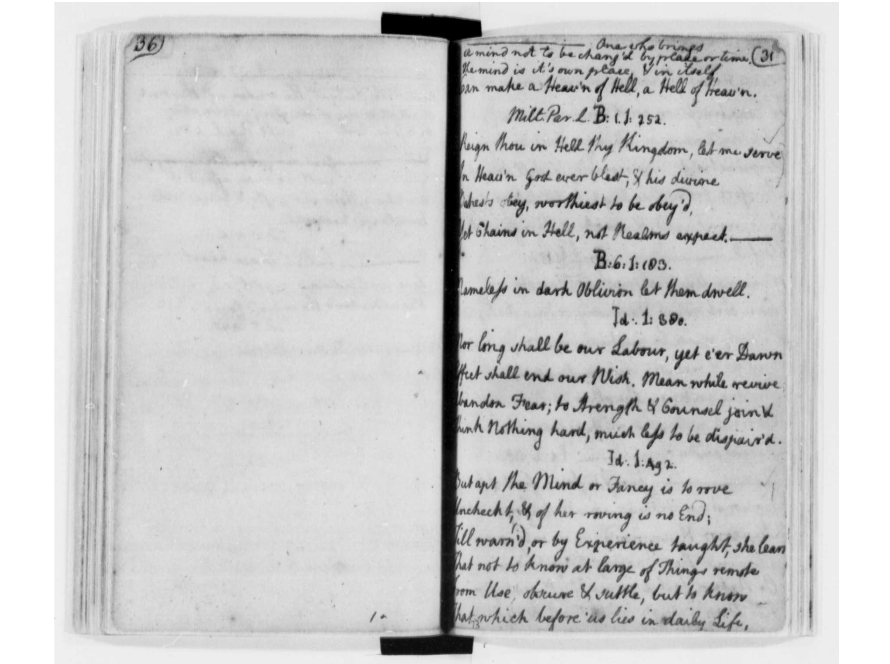
Jefferson was fascinated by Milton’s language of political rebellion—a rhetoric that Jefferson would take up and make his own during the Revolutionary War.
While literary and rhetorical studies helped Jefferson become the powerful writer who penned the Declaration of Independence, he depended upon his deep understanding of the law, which he studied assiduously in two other commonplace books: the Legal Commonplace Book and the Equity Commonplace Book.
Jefferson’s Legal Commonplace Book
Thomas Jefferson passed his bar examination in late 1765; at around that time, he began a new commonplace book to record what he learned from studying legal reports.3
Jefferson thought of commonplacing as a way to train his mind. As he read through cases, he tried to reduce them to their most essential parts. This was a difficult skill for him to develop, as he confessed to his nephew:
I remember when I began a regular course of study. I determined to abridge in a common place book, every thing of value which I read. at first I could shorten it very little: but after a while I was able to put a page of a book into 2. or 3. sentences, without omitting any portion of the substance. go on therefore with courage & you will find it grows easier and easier. besides obliging you to understand the subject, & fixing it in your memory, it will learn you the most valuable art of condensing your thoughts & expressing them in the fewest words possible.4
This is Jefferson’s method in his Legal Commonplace Book, in which he amassed over 900 entries:
He numbered entries
He condensed cases into principles
Then, he cited the case from which he derived the rule.
Here’s an example related to warrants:
117. if a warrant be directed to a Constable by name he may execute it out of his precinct if he will; but otherwise if it is directed to all constables in general. case of Vill. of Chorley. 1. Salk. 175.
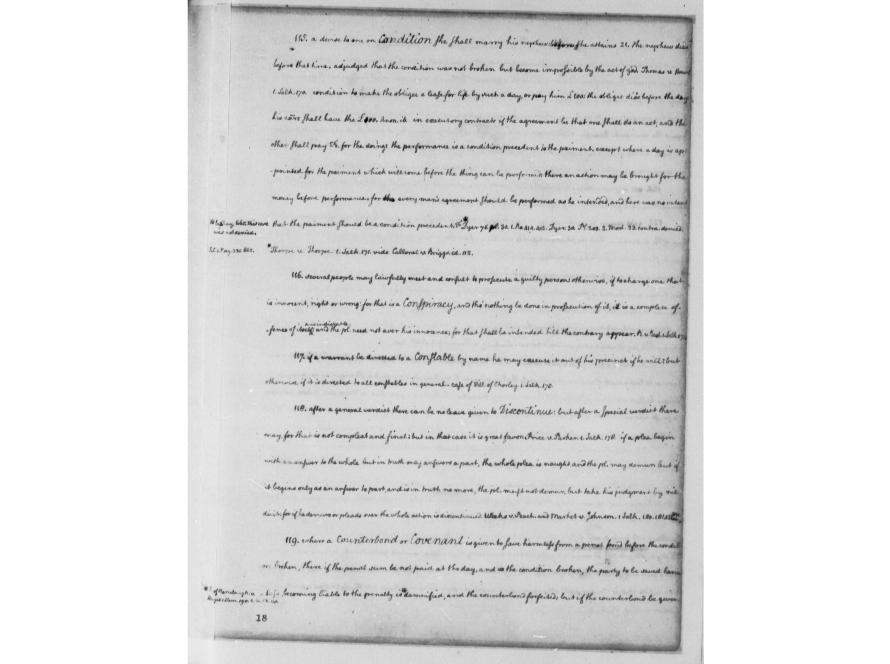
Originally, Jefferson relied on William Salkeld’s (1671–1715) reports; however, as he worked, he began to cross-reference each entry with Lord Raymond’s (1673-1733) report, which you can see in the left margin in the above page.5
The point of Jefferson’s Legal Commonplace Book was to support his memory and enhance his own legal reasoning. But even with 905 entries,6 this commonplace book was not enough. He soon created another one.
Jefferson’s Equity Commonplace Book
Jefferson did not stop with common law. While creating his Legal Commonplace Book, he realized he needed a new notebook devoted to Equity Law. Jefferson eventually wrote 2018 entries in this new commonplace book.
Equity Law was a separate legal branch during Jefferson’s time, and it was like the conscience of the law. Developed in medieval England for cases that didn’t quite fit the strictures of Common Law, Equity Law was argued in a separate place—the Court of Chancery.
So rather than focusing on technical legality, the Court of Chancery focused on what was fair.7 In designating a commonplace book for legal precedent and another for legal judgment, Jefferson differentiated between two kinds of knowledge. With his Equity Commonplace Book, he considered legal gray areas. In this sense, Jefferson was thinking about what happens when rules fail to produce justice.
Among the more interesting aspects of Jefferson’s Equity Commonplace book is how frequently he returns to “Natural Justice,” which clearly pertains to The Declaration of Independence with its opening sentence:
When, in the course of human events, it becomes necessary for one people to dissolve the political bands which have connected them with another, and to assume among the powers of the earth the separate and equal station to which the laws of nature and of nature’s God entitle them, a decent respect to the opinions of mankind requires that they should declare the causes which impel them to the separation.
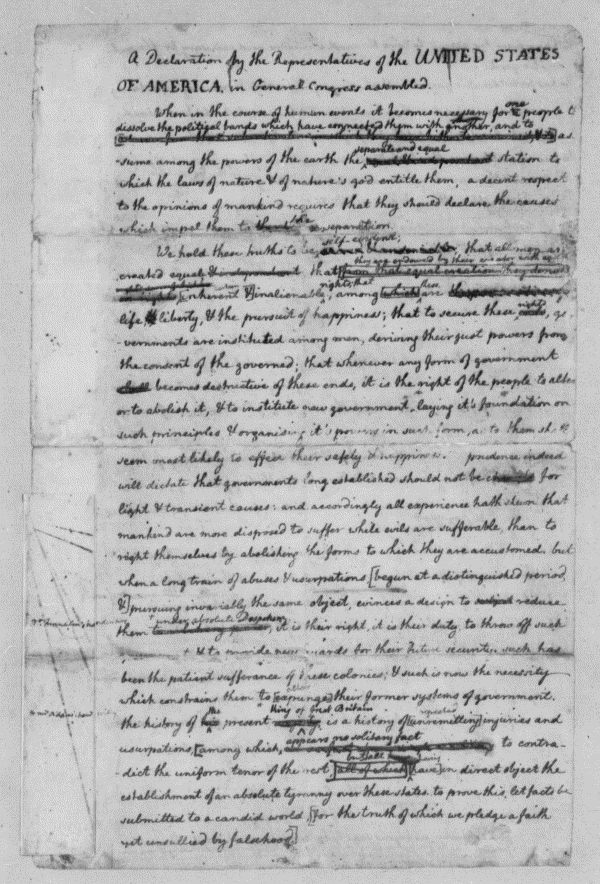
The Equity Commonplace Book, now housed in the Huntington Library, helps us see the moral and legal vocabulary that shaped Jefferson’s thinking before he drafted the Declaration of Independence.

Taken together, these three commonplace books give us a sense of Jefferson as a serious legal scholar: He studied literature for insights into language, pored over legal history to understand precedent, and studied equity for the moral aspects of jurisprudence.
While Jefferson’s Declaration of Independence seems inevitable today, he assembled it through many years of intensive reading, studying, and abstracting complicated ideas into an economy of sentences. Jefferson’s commonplace books remind us that brilliant writing and improbable revolutions are rarely born whole. Both take an extraordinary amount of private reading, studying, and writing.
Notes on Jefferson’s Notes:
Commonplace books can contain more than quotes: When we think of commonplace books today, we often think of something like Jefferson’s literary collection. But 18th-century law students were also encouraged to keep commonplace books to store and categorize legal knowledge. In other words, commonplace books were understood to collect more than just quotes.
Commonplace books are great places to condense ideas: Rather than collecting quotations, Jefferson summarized legal cases and precedent in as few words as possible. This practice prepared Jefferson to become one of the most powerful writers of his day. He knew how to convey complicated ideas succinctly.
The law has never been black and white: Learning about Equity law was fascinating. It is a reminder that legal technicalities can only do so much. Often, human judgment is in play.
Noted is fueled by you. Your ❤️s and comments inspire me. As always, I would love to know your thoughts.
Yours in note-taking,

P.S.
I’m taking next week off. I’ll be back in your inboxes on July 6th!
P.P.S.
If you’d like to read more Early-American notes. Check out these posts from Noted’s archives:
Re-Noted: Benjamin Franklin's Productivity Notes

Benjamin Franklin (1706-1790) has been called the “patron saint of self-improvement guides” for good reason. He spent his life trying to live more perfectly. In his remarkable autobiography, Franklin recounts several ways he used his notebooks to work towards what he called “moral perfection.”

Walt Whitman's Fragmented Process

Walt Whitman (1819-1892) genuinely believed that poetry could heal the divisions he saw in nineteenth-century America. “The United States themselves,” he wrote, “are essentially the greatest poem.” And like a poem, opposing ideas could coexist.
Re-Noted: Ralph Waldo Emerson's "Wide World"

With the January Commonplace Book Club (CBC) upon us, I’m reposting this essay on one of history’s greatest commonplacers—and one of my favorite writers: Ralph Waldo Emerson.
The translation comes from the Loeb Classical Library edition: A. D. Godley, trans., Herodotus, 4 vols. (London, 1921) and is cited in Wilson, D. L. Jefferson’s Literary Commonplace Book. Princeton University Press, 2014, p.23.
Jefferson’s Literary Commonplace Book, p.25.
Konig, David Thomas. “Introduction.” Jefferson’s Legal Commonplace Book, edited by et al., Princeton University Press, 2019, p. 1.
TJ to Thomas Jefferson Randolph, 7 Dec. 1808 (Albert and Shirley Small Special Collections Library, University of Virginia, Charlottesville). Printed in Edwin Morris Betts and James Adams Bear, Jr., eds., The Family Letters of Thomas Jefferson (Columbia, Mo., 1966), pp. 368-9.
At the time, Salkeld and Raymond were among the most esteemed legal thinkers.
This number comes from Konig’s “Introduction” to Princeton University Press’s edition of Jefferson’s Legal Commonplace Book.
Really wonderful material, Jillian. Thanks for highlighting the three different types of commonplace books. There is so much to learn from this approach.
Some years ago I was teaching an undergraduate seminar on the history of copyright. For one session I brought in a replica of Jefferson's favorite metal dip pen, a bottle of ink, and a copy of the Library of America's "Thomas Jefferson: Writings". I passed the pen and ink and some good paper around the class so they could all try it out. I asked them to consider what it would be like to have been able to write so much with that pen as your primary tool. They were amazed.